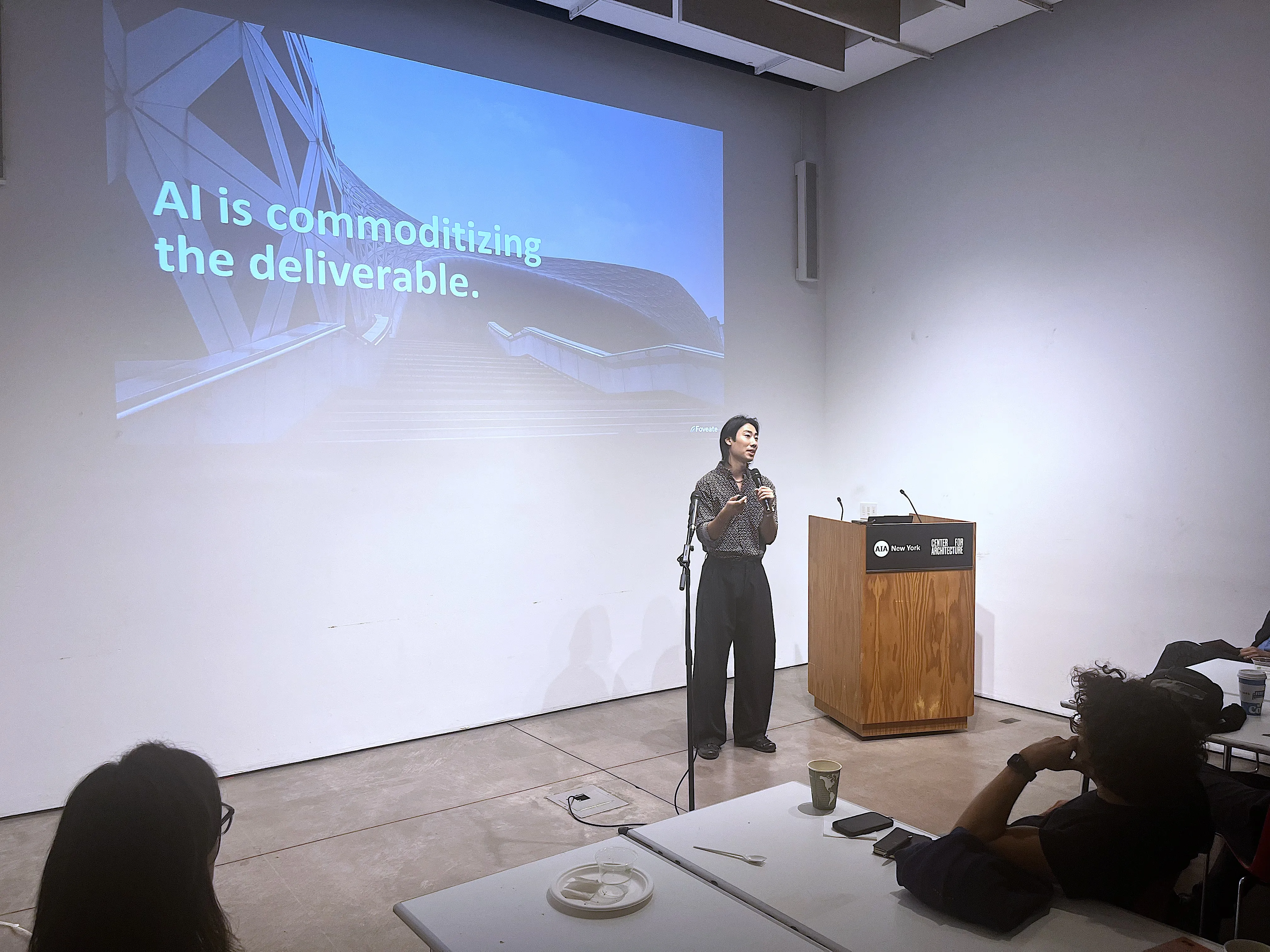
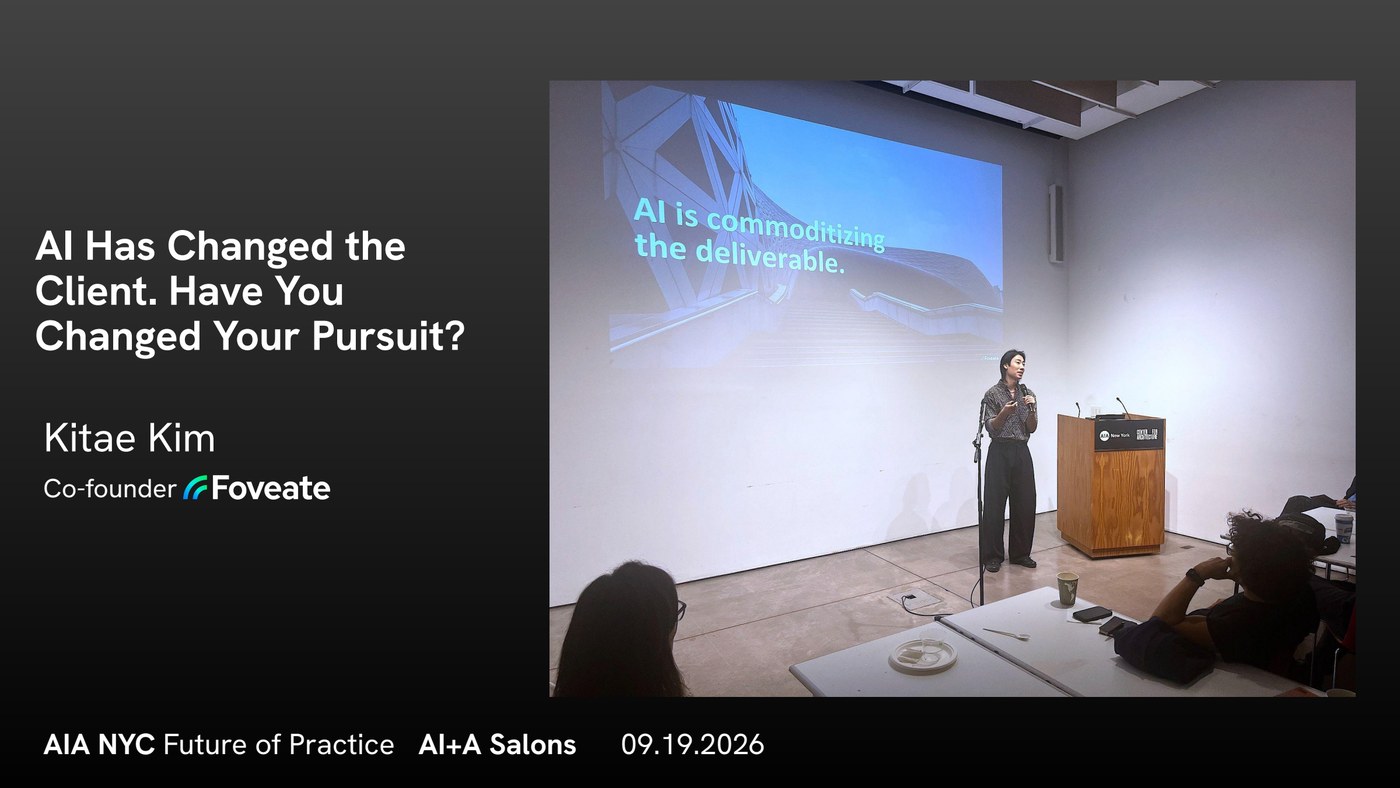
Last weekend I told a room of architects at AIA New York that the deliverable is going to zero. A few people laughed. Most didn't, because they already knew.
Renders, drawings, models, specs, proformas. The work we've billed by the hour for decades. Clients can regenerate most of it in an afternoon, and they've figured out how.
The argument, written out.
I sold unnecessary things for a living
Before Foveate, I spent a decade in the fine art world. I sold permanent installations, media facades, and public artworks to collectors, institutions, and governments. SFMOMA, Pace, Art Basel, the Venice Biennale.
None of it was necessary. All of it had to be sold.
When the thing you're selling is optional, and the buyer can afford anything, you learn fast what you're actually selling: the experience of working with you. The taste, the certainty, the feeling of being in expert hands.
That's what luxury service is. It's the whole game in the art world, and I think architecture is getting pushed into the same place.
The deliverable is collapsing
AI is pulling the price of the deliverable toward zero. The output we've charged for is getting cheap fast, and clients can watch it happen.
They see an image model spin up a city block in seconds. They feed a photo into a chatbot and get a massing study back. It scrambles their sense of what we do, which plenty of them already didn't fully understand or value.
So when a client runs our render through AI and gets new massing, new materiality, three alternatives in ten minutes, they're recalculating what our work is worth. And it's not only renders. It's our presentations, our feasibility narratives, our proformas.
The asymmetry runs the other way too. A developer can feed our project history, our team's LinkedIn, and our old proposals into AI, compare four firms in an afternoon, and generate interview questions to test whether we've done the work or just rendered it.
The information gap that used to protect us now exposes us.
We've been vendors for decades
Here's the uncomfortable part. This started long before AI.
We compete on fee. We discount to get on shortlists, give away concepts to win work, and anchor our value to the cost of what we produce.
BIM made us faster and we handed the savings straight back. AI just dropped the floor lower. And we justify it the same way every time: if the fee is too high, the client picks someone else.
But look at the actual money. An Oxford database of 16,000 projects found the average building runs 62% over budget. Nine in ten miss the budget or the schedule. The owner pays it, every time. (Flyvbjerg and Gardner, How Big Things Get Done, if you want to check me.)
The money was always there. We just kept charging for the wrong thing, and discounting the one thing that's getting harder to replace.
What we're actually selling now
There are two ways to sit in a client's mind.
A vendor gets compared on price, squeezed on fees, and replaced. A partner gets chosen on trust, retained across projects, and called before the RFP goes out.
The work has moved from the building to the partnership. And a partnership is a relationship. You can't email it over as a PDF.
The catch: you can't charge partner fees while you behave like a vendor. The overrun math proves clients will pay for a partner. The behavior is what they're paying for.
The pursuit is still stuck in 1999
Look at how most firms actually chase work.
An RFP lands. We start from scratch, three weeks of nights and weekends, four people deep. We email a PDF into a black box and wonder if anyone opened it. No memory across pursuits. No feedback loop.
And the waste is the quiet scandal. For every $10 of work we win, we propose $30 to $40 worth. The rest goes in the trash.
That's pure processing, and processing is what gets you replaced.
The shift: from producing to serving
The edge here comes from changing what you are, from producing deliverables to designing the client experience. Better AI tools are table stakes; everyone will have them.
Three moves.
Understand them better than anyone else in the running. Research the client and the committee before you write a word. What they've chosen before, what they value, what they're afraid of.
Remember everything. Every person, conversation, and past project should compound, so the client never has to repeat themselves and the knowledge doesn't walk out the door when someone quits.
Anticipate the need. Read what they respond to, solve the problem before they raise it, and tailor every step to them.
Understood, remembered, anticipated. That's what Aman does with a hotel room and Hermès does with a bag. They sell the feeling of being completely understood, and people pay a premium for it gladly.
That shift happens during the pursuit, long before contract signing. The pursuit is the first project, whether we treat it that way or not.
The client experience is the new design service
Which brings me back to where I started.
In the art world, the object was never the valuable part. The experience was. Architecture is being pushed into that same truth.
The value has moved from what we produce to how we make the client feel about choosing us. We're designing the relationship now, as much as the building.
The firms that figure that out first will win more work, and they'll set the terms for what this profession becomes.
This is the whole reason I'm building Foveate. More on that soon.
Frequently Asked Questions
Why is AI making architecture deliverables less valuable? Because the output itself, renders, massing studies, feasibility narratives, is now something a client can generate in minutes with a general-purpose AI tool. When the deliverable is cheap to reproduce, billing by the hour for it stops holding up, and clients are increasingly aware of it.
Does this mean architecture fees are going to fall? Not necessarily, but the fee has to move to a different part of the relationship. Research on megaprojects (Flyvbjerg and Gardner's Oxford database of 16,000 projects) found the average project runs 62% over budget, with nine in ten missing budget or schedule. Owners already pay for that risk. The opportunity is charging for the partnership that actually reduces it, not for a deliverable AI can now approximate.
What does it mean to say "the pursuit is the first project"? It means how a firm behaves before a contract is signed, whether it researches the client and committee, remembers past interactions, and anticipates what they need, is itself evidence of how the firm will behave during the real project. A committee is reading that evidence whether or not a firm intends to send it.
How does a firm actually act like a partner instead of a vendor during the pursuit? Three things: understand the client and committee better than any competing firm before writing a word, retain what's learned across every pursuit and every person so nothing has to be repeated, and anticipate what the client needs next instead of reacting to it. That's the same experience luxury brands sell, applied to a pursuit.
The talk, as a PDF
The Future of Practice
The full deck from the AIA New York talk this essay is drawn from, on what AI is doing to the architectural deliverable and what to do about it.
We'll also send you occasional product updates. Unsubscribe anytime.
About the Author

Kitae Kim
Architect with 10 years of experience in design and client communication. Co-founder of Foveate, the pursuit and client experience platform for AEC firms. Former studio lead who saw too many winning designs lose to worse proposals.
More on finding better clients
Insights
Business Development for Architecture Firms
Most architecture firms treat business development as something that happens between projects. The firms winning the most competitive work treat it as the project. Here's the complete lifecycle: positioning, prospecting, qualifying, proposing, following up, and growing accounts.
How To
How to Find Clients as an Architect: Beyond Referrals
Most architects find clients through referrals. This works—until it doesn't. Referral-dependent practices have no control over their pipeline. Here are 6 strategies to supplement referrals with intentional client acquisition.
Insights
Stop Marketing to Other Architects: How to Reach the Clients Who Actually Hire You
Architecture firms spend millions chasing features on ArchDaily and Instagram followers who'll never hire them. Your actual clients—developers, hospital CFOs, corporate facilities managers—are somewhere else entirely. Here's where to find them.
This article is part of our guide to architecture business development.
Explore Foveate for Architecture Firms